Elad Katz - Cool Stories

Tuesday, May 24, 2011

Google and Sprint team up to take your digital dollars with new NFC payment system? (updated)

Google and Sprint team up to take your digital dollars with new NFC payment system? (updated): "


There's been rumors of a Google-fied mobile payment system for some time, and now it looks like the Mountain View crew is teaming up with Sprint to finally make it happen. Last month, we heard that the Now Network would bring NFC payments to its customers this year, and Bloomberg reports that the partnership and payment system will make its debut on May 26th. Apparently, New York, San Francisco, Los Angeles, Chicago, and Washington D.C. are the first cities getting the service, which is a much broader initial footprint than its Isis mobile payment competition. The anonymous sources also say that Verifone and Vivotech are providing the hardware and software that will let you replace your credit card with a Nexus S -- because you always wanted to replace your credit card with your Nexus S.


Update: According to All things D, the payment system will be put through its paces by none other than El Goog's Executive Chairman Eric Schmidt at the D9: All Things Digital conference next week -- where we'll be on hand to peep the contactless payment presentation in person.

Google and Sprint team up to take your digital dollars with new NFC payment system? (updated) originally appeared on Engadget on Tue, 24 May 2011 15:06:00 EDT. Please see our terms for use of feeds.

Permalink | sourceBloomberg, All Things D | Email this | Comments"

Monday, May 23, 2011

Smartphone buyer's guide: the best phones for Verizon, AT&T, Sprint, T-Mobile, and more!

Smartphone buyer's guide: the best phones for Verizon, AT&T, Sprint, T-Mobile, and more!: "


The world of smartphones changes mighty quickly, and if you blink, you're bound to miss the latest and most delectable devices. That's where we come in, to provide timely roundups of everything your friends expect you to know, along with the insight that you crave. To bring you up to speed, in our December buyer's guide, at first blush you might have thought we were doing an overview of the best Android phones on the market. That's because of our 16 highly-esteemed handsets, a whopping 13 of them had Google's operating system at the core. As you'll see, the landscape has changed somewhat, and these new contenders that have come out swinging.


We've broken down this buyer's guide by mobile carrier, each including the best handset money can buy, our favorite QWERTY alternative, and the most well-rounded budget phone available (with $79 as the absolute ceiling). For smaller US providers, we're providing a single selection, though we're confident it's a good one. You'll definitely be presented with some difficult choices, but that's merely a testament to the abundance of stellar phones that aggressively compete for your dollar. With that said, let's dive in -- it's roundup time.

Continue reading Smartphone buyer's guide: the best phones for Verizon, AT&T, Sprint, T-Mobile, and more!

Smartphone buyer's guide: the best phones for Verizon, AT&T, Sprint, T-Mobile, and more! originally appeared on Engadget on Mon, 23 May 2011 12:00:00 EDT. Please see our terms for use of feeds.

Permalink | | Email this | Comments"

Tuesday, May 10, 2011

Google Ice Cream Sandwich coming in Q4 2011 to smartphones and tablets alike

Google Ice Cream Sandwich coming in Q4 2011 to smartphones and tablets alike: "


'One OS that runs everywhere.' There you have it, folks! Google intends to meld its Honeycomb tablet wares and Gingerbread smartphone software into one delicious Ice Cream Sandwich. Maybe that's why the 'sandwich' bit is in the name? Either way, it'll be a universal OS that runs on everything from teeny tiny Android phones to 10-inch tablets and will intelligently adapt to each form factor with things like a resizable status bar. Some other fancy new additions are being demonstrated right now, including face-tracking and camera focus shifting based on voice recognition.

Google Ice Cream Sandwich coming in Q4 2011 to smartphones and tablets alike originally appeared on Engadget on Tue, 10 May 2011 12:14:00 EDT. Please see our terms for use of feeds.

Permalink | | Email this | Comments"

Google Music Beta to stream 20,000 songs for free, official! (updated)

Google Music Beta to stream 20,000 songs for free, official! (updated): "


It's not quite official but there's little doubt that Google will launch its Google Music service at its big I/O event later today. While the Wall Street Journal couldn't get a Google spokesman to admit it, Peter Kafka over at All Things D got Jamie Rosenberg, Director of Android Product Management, to spill the details a bit early. Google's service will essentially mimic the music locker functionality of Amazon's Cloud service, albeit without the ability to sell songs direct to consumers. Ouch. Unfortunately, Google's plans to launch a more feature-complete service were derailed when discussions with the labels broke down. According to Rosenberg, 'A couple of the major labels were less focused on the innovative vision that we put forward, and more interested in an unreasonable and unsustainable set of business terms.' So, rather than putting the service on hold, Google will launch its music service with the ability to store up to 20,000 of your own uploaded songs for free which you can then stream over the web to your desktop or Android phone or tablet -- any device that supports Flash (don't worry iOS users, your time will come). Amazon's service, by comparison, offers just 5GB of free storage for about 1,200 songs stored at a mediocre bitrate. Google will also best Amazon with a feature that automatically creates playlists. Google expects to roll out the service to its US users within 'weeks' with Music Beta invites going out later today to Verizon Xoom owners (others will be able to sign up at music.google.com). Keep it right here because we'll be bringing you the announcement live.


Update: And it's officially official, called 'Music Beta by Google' at this point. There's a simple presentation with artists, albums, and easy playlist creation. You can manually create them, or there's a feature called 'Instant Mix' that will make you a playlist based on any single song. It'll automagically pick 25 different tracks to build a 'truly ingenious mix.' You know, kind of like another, similarly intelligent service. All of this syncs to the cloud, which means no wires needed to download anything.


But, more importantly, songs can be cached locally. You can pick any song, album, or playlist to download onto storage, at an unknown quality. It's the same pinning idea that's in the new movies feature. That and more is demonstrated in the video below.


The service is launching in beta today, allowing 20,000 songs, and it'll be free -- 'at least while it's in beta.' Also, the updated music app is available now, which will work with any music on your phone and any phone running Android 2.2 or above. To get full-featured you can request a beta and get in line, but if you happen to be reading this from I/O you're in the beta. Congrats, you lucky bums!

Gallery: Google Music

Continue reading Google Music Beta to stream 20,000 songs for free, official! (updated)

Google Music Beta to stream 20,000 songs for free, official! (updated) originally appeared on Engadget on Tue, 10 May 2011 12:25:00 EDT. Please see our terms for use of feeds.

Permalink Wall Street Journal | sourceAll Things D, Google Music Beta | Email this | Comments"

Monday, April 11, 2011

CyanogenMod 7.0 is now final, ready for your consumption

CyanogenMod 7.0 is now final, ready for your consumption: "Is your phone manufacturer's Android ROM not treating you quite the way it should? Worry not, Cyanogen's got your back as usual and has just released the final v7.0 of the CyanogenMod, now based on Android 2.3.3. There's an extensive list of supported Android handsets, which is now also augmented with a couple of tablets: the B&N Nook Color and the Viewsonic G Tablet. As usual with custom ROMs, we advise reading up and making sure you know what you're doing before you do it, but if you're already up to speed on the latest in homebrewed Android, this is the moment you've been eagerly waiting for. Full details of the changes made in version 7 plus instructions on how to get it set up on your Android device can be found below.


[Thanks to everyone who sent this in]

CyanogenMod 7.0 is now final, ready for your consumption originally appeared on Engadget on Mon, 11 Apr 2011 04:07:00 EDT. Please see our terms for use of feeds.

Permalink | sourceCyanogenMod | Email this | Comments"

Thursday, April 7, 2011

Android chief Andy Rubin tackles open source qualms, says Honeycomb isn't 'one size fits all'

Android chief Andy Rubin tackles open source qualms, says Honeycomb isn't 'one size fits all': "

Google got a lot of flak for withholding the Android 3.0 source code, and plenty more when Businessweek sources claimed the company had set aside its open stance to dictate from a throne, but today the man who would allegedly sit atop the royal seat says it isn't so. Andy Rubin, the man in charge of Android, says that 'there are no lock-downs or restrictions against customizing UIs' nor 'any efforts to standardize the platform on any single chipset architecture' as have often been rumored before, and that when Honeycomb is finally ready for phones, Google will indeed release its source code. Overall, he claims that Android's position when it comes to open source hasn't changed since day one -- which is nice for those who would like to believe that Google's still sticking to its motto -- but that's not likely to appease companies cut out of the loop simply because they weren't part of the early adopter club. If Google's methods will reduce fragmentation, though, who are we to judge?


[Thanks to everyone who sent this in]

Android chief Andy Rubin tackles open source qualms, says Honeycomb isn't 'one size fits all' originally appeared on Engadget on Wed, 06 Apr 2011 22:13:00 EDT. Please see our terms for use of feeds.

Permalink | sourceAndroid Developers Blog | Email this | Comments"

Monday, March 7, 2011

You’ve got better things to do than wait in traffic

You’ve got better things to do than wait in traffic: "(Cross-posted on the LatLong Blog and Mobile Blog)


Ever been stuck in traffic, only to find out you’d have been better off going a bit out of your way to take a less congested route? If you’re like me, you probably hear the traffic report telling you what you already know: traffic is bad on the road you’re currently on, and you should have taken another. It doesn’t need to be this way, and we want to help. So we’re happy to announce that Google Maps Navigation (Beta) will now automatically route you around traffic. With more than 35 million miles driven by Navigation users every day, this should add up to quite a bit of time saved!


On a recent trip to New York, I was running late to meet some friends at the Queens Museum of Art. I had no idea that there was a traffic jam along the route I would normally have taken. Thankfully, Navigation routed me around traffic. I didn’t even have to know that there was a traffic jam on I-495, and I got to enjoy a much faster trip on I-278 instead.


Navigation now uses real-time traffic conditions to automatically route you around traffic.


You don’t have to do anything to be routed around traffic; just start Navigation like you normally would, either from the Navigation app or from within Google Maps. Before today, Navigation would choose whichever route was fastest, without taking current traffic conditions into account. It would also generate additional alternate directions, such as the shortest route or one that uses highways instead of side roads. Starting today, our routing algorithms will also apply our knowledge of current and historical traffic to select the fastest route from those alternates. That means that Navigation will automatically guide you along the best route given the current traffic conditions.


Not only can you save time and fuel, you’re making traffic better for everyone else by avoiding traffic jams. Keep in mind that we can’t guarantee that Navigation will be able to find a faster way, but it will always try to get you where you’re going as fast as possible.


You can begin routing around traffic with Google Maps Navigation for Android in North America and Europe where both Navigation and real-time traffic data are available.


Enjoy your newly found free time!


Posted by Roy Williams, Software Engineer, Google Maps Team


"

Thursday, February 24, 2011

Visualized: Android activations mapped geographically, chronologically, breathtakingly (video)

Visualized: Android activations mapped geographically, chronologically, breathtakingly (video): "

Do you ever wish for an easier way to show your uninitiated friends what you mean when you say Android is growing? Well, here's the video for you: a Google-produced map of the world that throbs with Android activations over time, highlighted by some truly eye-opening flourishes in the immediate aftermath of marquee handset launches. The Google guys have even given us handy countdown timers -- 'Droid launch in 3, 2, 1...' -- and broken things down by continent for easier viewing. Only thing missing is a soundtrack, so just have your Tron: Legacy OST loaded up and ready before jumping past the break.


[Thanks, Leo Z.]

Continue reading Visualized: Android activations mapped geographically, chronologically, breathtakingly (video)

Visualized: Android activations mapped geographically, chronologically, breathtakingly (video) originally appeared on Engadget on Thu, 24 Feb 2011 04:09:00 EDT. Please see our terms for use of feeds.

Permalink Android Central | sourceandroiddevelopers (YouTube) | Email this | Comments"

Thursday, February 17, 2011

Developer gets Kinect working on Android, rains on Microsoft's WP7 parade (video)

Developer gets Kinect working on Android, rains on Microsoft's WP7 parade (video): "
Developer gets Kinect working on Android, rains on Microsoft's WP7 parade

Windows Phone 7 is getting a lot of extensions this year and, while we wouldn't say Kinect interoperability is anywhere near as important as third-party multitasking, it could be fun. Still, we haven't seen proper Kinect interop, the sort that would see you controlling WP7 games with a Kinect -- the sort that is apparently possible on Android. YouTuber HirotakaSter has managed to hook a Kinect up to Android hardware, what looks to be an Armadillo 500 FX development platform, and get everything to play nice. He's using openFrameworks and, while at this point the software isn't doing much other than showing a video stream from the camera, the possibilities from here are quite simply infinite.


[Thanks, Muhammad Ali]

Continue reading Developer gets Kinect working on Android, rains on Microsoft's WP7 parade (video)

Developer gets Kinect working on Android, rains on Microsoft's WP7 parade (video) originally appeared on Engadget on Wed, 16 Feb 2011 22:58:00 EDT. Please see our terms for use of feeds.

Permalink Geekword | sourceKirotakaSter (YouTube) | Email this | Comments"

Wednesday, February 9, 2011

HP TouchPad vs. iPad vs. Xoom vs. PlayBook: the tale of the tape

HP TouchPad vs. iPad vs. Xoom vs. PlayBook: the tale of the tape: "

At last, the webOS-empowered TouchPad, HP's answer to the growing tablet market. And make no mistake, it's coming in with guns blazing -- specs-wise, the slate stands up pretty well to the competition currently in play (e.g. iPad) and the other up-and-comers not quite out the gate (e.g. Motorola Xoom and BlackBerry PlayBook). Stacked side-by-side, it's clear Apple's entry is lacking a bit in both memory (256MB vs. 1GB for everyone else) and front-facing camera -- not that we expect that to be the case for all of 2011. When it all comes down to it, what'll set these slates apart will be the platforms and software themselves -- should make for an interesting summer, no? In the meantime, for the nitty-gritty on technical specifications, venture past the break.

Continue reading HP TouchPad vs. iPad vs. Xoom vs. PlayBook: the tale of the tape

HP TouchPad vs. iPad vs. Xoom vs. PlayBook: the tale of the tape originally appeared on Engadget on Wed, 09 Feb 2011 16:30:00 EDT. Please see our terms for use of feeds.

Permalink | | Email this | Comments"

Monday, October 25, 2010

Samsung Android Event November 8th in NYC

Samsung Android Event November 8th in NYC: "


This image has no alt text

Samsung has been tearing it up with Android announcements lately and it looks like their streak of robotic sweetness will continue. They wowed us with a multi-carrier launch of the Samsung Galaxy S, launched the most impressive Android Tablet yet with the Samsung Galaxy Tab, and now they’ve announced a November 8th mobile event that will pretty obviously be all about Android:


samsungevent


The image features Android Application icons getting sucked into a vortex that is seemingly surrounded by stock prices and random numbers. I’m not exactly sure what Samsung will be announcing and the only thing they had to say about the matter, in addition to the above image, was:


Join Samsung Mobile for the unveiling of a new Android device.


Based on the image I thought perhaps Samsung would be announcing a store or marketplace of sorts but if they’ll be announcing a new Android DEVICE than it looks like we’ve got a LOT more to which we can look forward. I’m really excited because the holiday season seems to always have the hottest tech and the biggest surprises.


What do you think Samsung will announce?

"

Wednesday, October 20, 2010

Android 3.0 due to start hitting tablets in December ahead of January launch

Android 3.0 due to start hitting tablets in December ahead of January launch: "Android 3.0 due to start hitting tablets in December, launch in JanuaryA holiday tradition? Making things out of gingerbread, and Google is doing its part to keep that practice alive according to a report stating Android 3.0 is set to hit some tablets this December. Those will just be early samples destined only to light up the eyes of engineers who've been very, very good this year, but the rest of us naughty boys and girls will get to see those slates when they launch to the public in January. We hear there's a little electronics show happening that time of year, and supposedly HTC, Samsung, and Motorola will be showing their Gingerbread tablets there, amongst others (but not Lenovo, apparently). We can't wait to get a taste.


Update: Thanks to James for pointing out that it's still unclear whether 3.0 is going to be Gingerbread or, indeed, the truly tablet-minded Honeycomb release we're really waiting for. This report states specifically that 3.0 is hitting tablets in December, with 4.0 later in 2011. Is that Gingerbread and Honeycomb, or Honeycomb and Ice Cream? Also, is anyone else hungry?

Android 3.0 due to start hitting tablets in December ahead of January launch originally appeared on Engadget on Wed, 20 Oct 2010 12:21:00 EDT. Please see our terms for use of feeds.

Permalink | sourceDigiTimes | Email this | Comments"

Thursday, September 30, 2010

Six Android browsers enter the ring, only one reigns supreme

Six Android browsers enter the ring, only one reigns supreme: "
Six Android browsers enter the ring, only one reigns supreme

Choice is a good thing, and Android users certainly have a lot of choices. Default launcher or Launcher Pro? Fancy animated live wallpaper or static picture of adorable puppies? Stock browser or alternative? It's that last question that has plagued so many, and to offer some guidance PC World pitted six of the Market's top choices against each other. The 2.1 and 2.2 stock browsers entered, along with Skyfire 2.0, Opera Mini, Dolphin HD, and Mozilla Fennec (the pre-beta release of what could bring Firefox to your phone). The winner? Well, you can see the ultimate speed results above, with SkyFire surprisingly trumping Opera Mini, though that one seemingly has 'em beat when it comes to repeat-visits. However, the full story when it comes to things like page rendering and Flash compatibility is naturally a good bit more complex. For those details you'll need to click on through.


[Thanks, Tim]

Six Android browsers enter the ring, only one reigns supreme originally appeared on Engadget on Thu, 30 Sep 2010 02:52:00 EDT. Please see our terms for use of feeds.

Permalink | sourcePC World | Email this | Comments"

Friday, August 13, 2010

Chrome to Phone now available in Android Market

Chrome to Phone now available in Android Market: "

Chrome to Phone isn't a new product -- we've been using it since May, in fact -- but Google's second mobile announcement today (behind Voice Actions) is that its continuous client app is now 'official' and available to all users (with Android 2.2 Froyo) via Android Market. As it was before, websites can be pushed from the Chrome browser to your Android device, with certain apps (Maps, YouTube) taking over for the browser when contextually appropriate. Additionally, the code is open, which we're hoping means this Chrome extension will find its way to other browsers. The team is 'looking into' bringing the capabilities to other mobile OSs (the iPhone was specifically asked), but don't get your hopes up: nothing's been submitted, and we didn't get the feeling it was an active push. Incredibly useful? Yes, yes indeed.

Chrome to Phone now available in Android Market originally appeared on Engadget on Thu, 12 Aug 2010 13:29:00 EDT. Please see our terms for use of feeds.

Permalink | | Email this | Comments"

Thursday, July 22, 2010

T-Mobile Acknowledges their First HSPA+ Device to be Available This Summer!

T-Mobile Acknowledges their First HSPA+ Device to be Available This Summer!: "


This image has no alt text

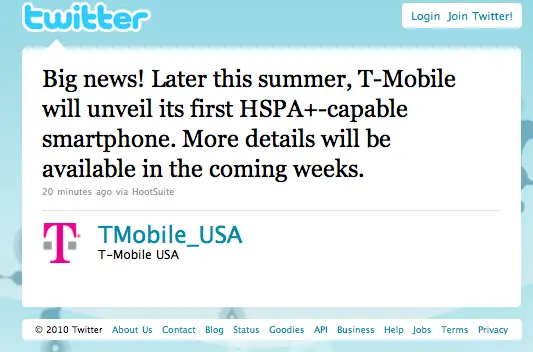
After all of the rumors surrounding T-Mobile’s first HSPA+ device – with just about everyone taking it to be the HTC Vision – T-Mobile’s official corporate Twitter account (for the United States) has given us reassurance that there will be a device out to take advantage of their marvelous new network later this summer.


hspa+ phone this summer tmobile


More details will be available in the coming weeks, you say? Well I certainly don’t mind if I do! If all of the rumors surrounding the HTC Vanguard/HTC Vision turn out to be true, then this will be the high-end, subsidized smartphone from HTC that a lot of you on “Magenta” have been waiting for (the Nexus One doesn’t count for various reasons, and I guess some of you just aren’t too big on Samsung’s Galaxy S phone for the carrier: the Samsung Vibrant).


We can’t wait to see what T-Mobile has to offer us as we head into August and expire the summer with September.


[via TmoNews]

"

Wednesday, July 21, 2010

Nexus One is sold out in Google's store -- forever

Nexus One is sold out in Google's store -- forever: "

Google warned us that the Nexus One was approaching the end of its days, but we've gotta admit, we didn't realize just how quickly that moment would come. Sure enough, Google's official online store for the phone now just shows an ominous message that 'the Nexus One is no longer available for purchase directly' from the company, which means you're going to have to go through Vodafone, KT in South Korea, or hold out for the units that they plan on selling directly to registered developers. Needless to say, for the bulk of potential customers, the phone is all but history. So, on that note, Nexus One: for your straight-shooting stock Android ways and your unlocked radio, you'll be dearly missed -- and we hope your legacy lives on, even though your retail model does not.


[Thanks, Dan]

Nexus One is sold out in Google's store -- forever originally appeared on Engadget on Wed, 21 Jul 2010 10:59:00 EDT. Please see our terms for use of feeds.

Permalink | sourceGoogle | Email this | Comments"

Google: Eclair is on more than half of all Android phones, Froyo bursts onto the scene

Google: Eclair is on more than half of all Android phones, Froyo bursts onto the scene: "

Android 1.5 and 1.6 are still major players in the field, together accounting for some 41 percent of all Google-powered phones in use as of July 15 -- but for the first time, Android 2.1 is on significantly more than half of the phones out there, up from an even 50 percent in mid-June. 55.5 percent of devices are running Eclair to be exact, and Froyo also makes an appearance with a little sliver of 3.3 percent -- an anemic figure obviously hampered by the fact that no one outside Google itself (on the now nearly-defunct Nexus One) has deployed the latest version yet. It's fascinating to see the change in the version mix over time get visualized like this -- now all we need is that dark green line at the very bottom to shoot upwards and obliterate everything else on the graph. Let's make it happen, guys.

Google: Eclair is on more than half of all Android phones, Froyo bursts onto the scene originally appeared on Engadget on Wed, 21 Jul 2010 13:38:00 EDT. Please see our terms for use of feeds.

Permalink GigaOM | sourceAndroid Developers | Email this | Comments"

Tuesday, July 20, 2010

Multithreading For Performance

Multithreading For Performance: "

[This post is by Gilles Debunne, an engineer in the Android group who loves to get multitasked. — Tim Bray]

A good practice in creating responsive applications is to make sure your main UI thread does the minimum amount of work. Any potentially long task that may hang your application should be handled in a different thread. Typical examples of such tasks are network operations, which involve unpredictable delays. Users will tolerate some pauses, especially if you provide feedback that something is in progress, but a frozen application gives them no clue.

In this article, we will create a simple image downloader that illustrates this pattern. We will populate a ListView with thumbnail images downloaded from the internet. Creating an asynchronous task that downloads in the background will keep our application fast.

An Image downloader

Downloading an image from the web is fairly simple, using the HTTP-related classes provided by the framework. Here is a possible implementation:

static Bitmap downloadBitmap(String url) {
final AndroidHttpClient client = AndroidHttpClient.newInstance('Android');
final HttpGet getRequest = new HttpGet(url);

try {
HttpResponse response = client.execute(getRequest);
final int statusCode = response.getStatusLine().getStatusCode();
if (statusCode != HttpStatus.SC_OK) {
Log.w('ImageDownloader', 'Error ' + statusCode + ' while retrieving bitmap from ' + url);
return null;
}

final HttpEntity entity = response.getEntity();
if (entity != null) {
InputStream inputStream = null;
try {
inputStream = entity.getContent();
final Bitmap bitmap = BitmapFactory.decodeStream(inputStream);
return bitmap;
} finally {
if (inputStream != null) {
inputStream.close();
}
entity.consumeContent();
}
}
} catch (Exception e) {
// Could provide a more explicit error message for IOException or IllegalStateException
getRequest.abort();
Log.w('ImageDownloader', 'Error while retrieving bitmap from ' + url, e.toString());
} finally {
if (client != null) {
client.close();
}
}
return null;
}

A client and an HTTP request are created. If the request succeeds, the response entity stream containing the image is decoded to create the resulting Bitmap. Your applications' manifest must ask for the INTERNET to make this possible.

Note: a bug in the previous versions of BitmapFactory.decodeStream may prevent this code from working over a slow connection. Decode a new FlushedInputStream(inputStream) instead to fix the problem. Here is the implementation of this helper class:

static class FlushedInputStream extends FilterInputStream {
public FlushedInputStream(InputStream inputStream) {
super(inputStream);
}

@Override
public long skip(long n) throws IOException {
long totalBytesSkipped = 0L;
while (totalBytesSkipped < n) {
long bytesSkipped = in.skip(n - totalBytesSkipped);
if (bytesSkipped == 0L) {
int byte = read();
if (byte < 0) {
break; // we reached EOF
} else {
bytesSkipped = 1; // we read one byte
}
}
totalBytesSkipped += bytesSkipped;
}
return totalBytesSkipped;
}
}

This ensures that skip() actually skips the provided number of bytes, unless we reach the end of file.

If you were to directly use this method in your ListAdapter's getView method, the resulting scrolling would be unpleasantly jaggy. Each display of a new view has to wait for an image download, which prevents smooth scrolling.

Indeed, this is such a bad idea that the AndroidHttpClient does not allow itself to be started from the main thread. The above code will display 'This thread forbids HTTP requests' error messages instead. Use the DefaultHttpClient instead if you really want to shoot yourself in the foot.

Introducing asynchronous tasks

The AsyncTask class provides one of the simplest ways to fire off a new task from the UI thread. Let's create an ImageDownloader class which will be in charge of creating these tasks. It will provide a download method which will assign an image downloaded from its URL to an ImageView:

public class ImageDownloader {

public void download(String url, ImageView imageView) {
BitmapDownloaderTask task = new BitmapDownloaderTask(imageView);
task.execute(url);
}
}

/* class BitmapDownloaderTask, see below */
}

The BitmapDownloaderTask is the AsyncTask which will actually download the image. It is started using execute, which returns immediately hence making this method really fast which is the whole purpose since it will be called from the UI thread. Here is the implementation of this class:

class BitmapDownloaderTask extends AsyncTask<String, Void, Bitmap> {
private String url;
private final WeakReference<ImageView> imageViewReference;

public BitmapDownloaderTask(ImageView imageView) {
imageViewReference = new WeakReference<ImageView>(imageView);
}

@Override
// Actual download method, run in the task thread
protected Bitmap doInBackground(String... params) {
// params comes from the execute() call: params[0] is the url.
return downloadBitmap(params[0]);
}

@Override
// Once the image is downloaded, associates it to the imageView
protected void onPostExecute(Bitmap bitmap) {
if (isCancelled()) {
bitmap = null;
}

if (imageViewReference != null) {
ImageView imageView = imageViewReference.get();
if (imageView != null) {
imageView.setImageBitmap(bitmap);
}
}
}
}

The doInBackground method is the one which is actually run in its own process by the task. It simply uses the downloadBitmap method we implemented at the beginning of this article.

onPostExecute is run in the calling UI thread when the task is finished. It takes the resulting Bitmap as a parameter, which is simply associated with the imageView that was provided to download and was stored in the BitmapDownloaderTask. Note that this ImageView is stored as a WeakReference, so that a download in progress does not prevent a killed activity's ImageView from being garbage collected. This explains why we have to check that both the weak reference and the imageView are not null (i.e. were not collected) before using them in onPostExecute.

This simplified example illustrates the use on an AsyncTask, and if you try it, you'll see that these few lines of code actually dramatically improved the performance of the ListView which now scrolls smoothly. Read Painless threading for more details on AsyncTasks.

However, a ListView-specific behavior reveals a problem with our current implementation. Indeed, for memory efficiency reasons, ListView recycles the views that are displayed when the user scrolls. If one flings the list, a given ImageView object will be used many times. Each time it is displayed the ImageView correctly triggers an image download task, which will eventually change its image. So where is the problem? As with most parallel applications, the key issue is in the ordering. In our case, there's no guarantee that the download tasks will finish in the order in which they were started. The result is that the image finally displayed in the list may come from a previous item, which simply happened to have taken longer to download. This is not an issue if the images you download are bound once and for all to given ImageViews, but let's fix it for the common case where they are used in a list.

Handling concurrency

To solve this issue, we should remember the order of the downloads, so that the last started one is the one that will effectively be displayed. It is indeed sufficient for each ImageView to remember its last download. We will add this extra information in the ImageView using a dedicated Drawable subclass, which will be temporarily bind to the ImageView while the download is in progress. Here is the code of our DownloadedDrawable class:

static class DownloadedDrawable extends ColorDrawable {
private final WeakReference<BitmapDownloaderTask> bitmapDownloaderTaskReference;

public DownloadedDrawable(BitmapDownloaderTask bitmapDownloaderTask) {
super(Color.BLACK);
bitmapDownloaderTaskReference =
new WeakReference<BitmapDownloaderTask>(bitmapDownloaderTask);
}

public BitmapDownloaderTask getBitmapDownloaderTask() {
return bitmapDownloaderTaskReference.get();
}
}

This implementation is backed by a ColorDrawable, which will result in the ImageView displaying a black background while its download is in progress. One could use a “download in progress” image instead, which would provide feedback to the user. Once again, note the use of a WeakReference to limit object dependencies.

Let's change our code to take this new class into account. First, the download method will now create an instance of this class and associate it with the imageView:

public void download(String url, ImageView imageView) {
if (cancelPotentialDownload(url, imageView)) {
BitmapDownloaderTask task = new BitmapDownloaderTask(imageView);
DownloadedDrawable downloadedDrawable = new DownloadedDrawable(task);
imageView.setImageDrawable(downloadedDrawable);
task.execute(url, cookie);
}
}

The cancelPotentialDownload method will stop the possible download in progress on this imageView since a new one is about to start. Note that this is not sufficient to guarantee that the newest download is always displayed, since the task may be finished, waiting in its onPostExecute method, which may still may be executed after the one of this new download.

private static boolean cancelPotentialDownload(String url, ImageView imageView) {
BitmapDownloaderTask bitmapDownloaderTask = getBitmapDownloaderTask(imageView);

if (bitmapDownloaderTask != null) {
String bitmapUrl = bitmapDownloaderTask.url;
if ((bitmapUrl == null) || (!bitmapUrl.equals(url))) {
bitmapDownloaderTask.cancel(true);
} else {
// The same URL is already being downloaded.
return false;
}
}
return true;
}

cancelPotentialDownload uses the cancel method of the AsyncTask class to stop the download in progress. It returns true most of the time, so that the download can be started in download. The only reason we don't want this to happen is when a download is already in progress on the same URL in which case we let it continue. Note that with this implementation, if an ImageView is garbage collected, its associated download is not stopped. A RecyclerListener might be used for that.

This method uses a helper getBitmapDownloaderTask function, which is pretty straigthforward:

private static BitmapDownloaderTask getBitmapDownloaderTask(ImageView imageView) {
if (imageView != null) {
Drawable drawable = imageView.getDrawable();
if (drawable instanceof DownloadedDrawable) {
DownloadedDrawable downloadedDrawable = (DownloadedDrawable)drawable;
return downloadedDrawable.getBitmapDownloaderTask();
}
}
return null;
}

Finally, onPostExecute has to be modified so that it will bind the Bitmap only if this ImageView is still associated with this download process:

if (imageViewReference != null) {
ImageView imageView = imageViewReference.get();
BitmapDownloaderTask bitmapDownloaderTask = getBitmapDownloaderTask(imageView);
// Change bitmap only if this process is still associated with it
if (this == bitmapDownloaderTask) {
imageView.setImageBitmap(bitmap);
}
}

With these modifications, our ImageDownloader class provides the basic services we expect from it. Feel free to use it or the asynchronous pattern it illustrates in your applications to ensure their responsiveness.

Demo

The source code of this article is available online on Google Code. You can switch between and compare the three different implementations that are described in this article (no asynchronous task, no bitmap to task association and the final correct version). Note that the cache size has been limited to 10 images to better demonstrate the issues.

Future work

This code was simplified to focus on its parallel aspects and many useful features are missing from our implementation. The ImageDownloader class would first clearly benefit from a cache, especially if it is used in conjuction with a ListView, which will probably display the same image many times as the user scrolls back and forth. This can easily be implemented using a Least Recently Used cache backed by a LinkedHashMap of URL to Bitmap SoftReferences. More involved cache mechanism could also rely on a local disk storage of the image. Thumbnails creation and image resizing could also be added if needed.

Download errors and time-outs are correctly handled by our implementation, which will return a null Bitmap in these case. One may want to display an error image instead.

Our HTTP request is pretty simple. One may want to add parameters or cookies to the request as required by certain web sites.

The AsyncTask class used in this article is a really convenient and easy way to defer some work from the UI thread. You may want to use the Handler class to have a finer control on what you do, such as controlling the total number of download threads which are running in parallel in this case.


"